There are few upgrades you can make to improve your home’s energy efficiency that are as effective as spray foam insulation. It doesn’t just slow down heat transfer; it creates an air seal that helps keep your indoor temperatures stable year-round. What you need to figure out is where to put the spray foam: the roof deck or the attic floor.
Spray Foam on the Attic Floor (Vented Attic)
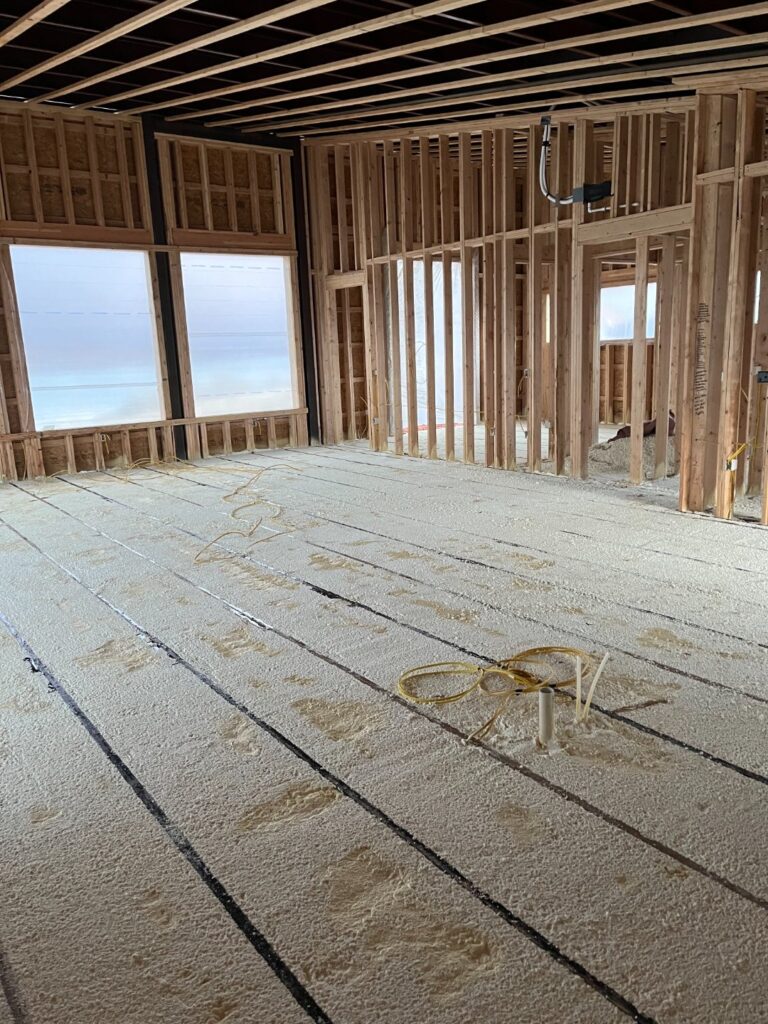
Applying spray foam directly onto your attic floor or ceiling joists is a standard method of insulating your home.
Pros vs Cons of Spray Foam on the Attic Floor
- Pro: Improved air sealing – Spray foam expands to fill gaps and creates a tight, continuous barrier against:
- Air leakageDust
- Pests
- Con: Potential for air leakage – When sealing, you may miss a spot or two, allowing air to pass between the attic and the living space. Be sure to check for leaks in your home and plug them with the right materials to maximize the effectiveness of your insulation. You can always contact professionals to do it.
- Pro: High thermal performance – Effectively maintains the ideal temperature of your home for longer.
- Con: Temperature extremes in the attic – The attic space remains cold in winter and hot in summer, making it unusable for storage.
- Pro: Reduced energy costs – Preventing heat loss and gain – by up to 20% in some cases – can significantly lower utility bills.
- Con: Reduced HVAC efficiency – HVAC systems in a vented attic are exposed to extreme temperatures. This can make them inefficient, greatly increasing your energy costs.
- Pro: Simpler system design – The process of installing insulation is straightforward.
- Con: Difficult retrofitting – Closed-cell spray foam – not ideal for attic floors – sets rigidly, making future electrical or plumbing work in the attic difficult.
- Pro: Cost-effective application – Smaller surface area to cover, so there are fewer materials to pay for.
- Pro: Easier leak detection – Because the attic is not sealed along the roofline, it’s easier to spot – and deal with – leaks.
- Con: Moisture and mold risks – If not installed properly, spray foam can trap moisture and cause mold or damage to the roof structure.
Best Use Cases
- Homes without HVAC equipment in the attic
- Attics that are used infrequently and for minimal storage
- Homeowners working with a tighter budget
- Homes in milder climates where extreme temperature control is less critical
- Homes that were designed for ventilation
Spray Foam on the Roof Deck (Unvented Attic)
Applying spray foam on the roof deck creates a “hot roof” system that acts as an air barrier and insulation. Your attic is included in the “conditioned” envelope of your home. Its temperature stays much closer to the rest of your home. This creates a more stable and controlled environment.
Pros vs Cons of Spray Foam on the Roof Deck
- Pro: Improved energy efficiency – Provides a tighter building envelope that prevents air leakage.
- Con: High upfront cost – Because roof decks have a larger surface area, they require more material and labor to cover.
- Pro: Prevents ice dams – Ice dams are caused by a rapid melting/refreezing cycle that’s usually triggered by heat escaping from the house into the attic. When the roof deck is insulated, the surface of the roof should maintain a consistent temperature, therefore bypassing the issue.
- Pro: Improved structural integrity – Closed-cell foam – the recommended choice for roof decks – can reinforce the roof deck and increase its strength against wind uplift.
- Con: Hidden leaks – Small leaks are difficult to spot because water may travel along the foam – which is adhered directly to the roof deck – before becoming visible elsewhere.
- Pro: Versatility – Insulating your roof deck is a great option if you want to improve how space is used in an older home. It also works well for homes with cathedral ceilings or complex roof shapes that make traditional ventilation difficult.
- Con: Sensitive installation – You need a professional team on hand to install the foam precisely on a dry surface under ideal conditions. Cold or damp environments can lengthen the insulation process.
An experienced team will also avoid any damaging overspray.
- Pro: HVAC equipment operates more effectively – If installed in the attic, it benefits from being in a conditioned space, which reduces energy loss.
- Pro: Moisture and air control – The air seal created by spray foam reduces the chance of humid air infiltration. This helps lower the risk of condensation and mold growth.
- Con: Shrinkage risk – Spray foam that doesn’t cure correctly can shrink, which causes gaps and allows air to leak.
Best Use Cases
- Homes with HVAC systems or ductwork in the attic,
- Homeowners who want maximum energy efficiency,
- Attics that are frequently used – either for storage or as a separate living space,
- Homes built in areas with extreme climates,
- Homes with cathedral ceilings.
Insulating your attic is a massive task – one that you want done correctly the first time. Don’t DIY. Reach out to Seamless Systems and let our team of experts handle the difficult part for you.