
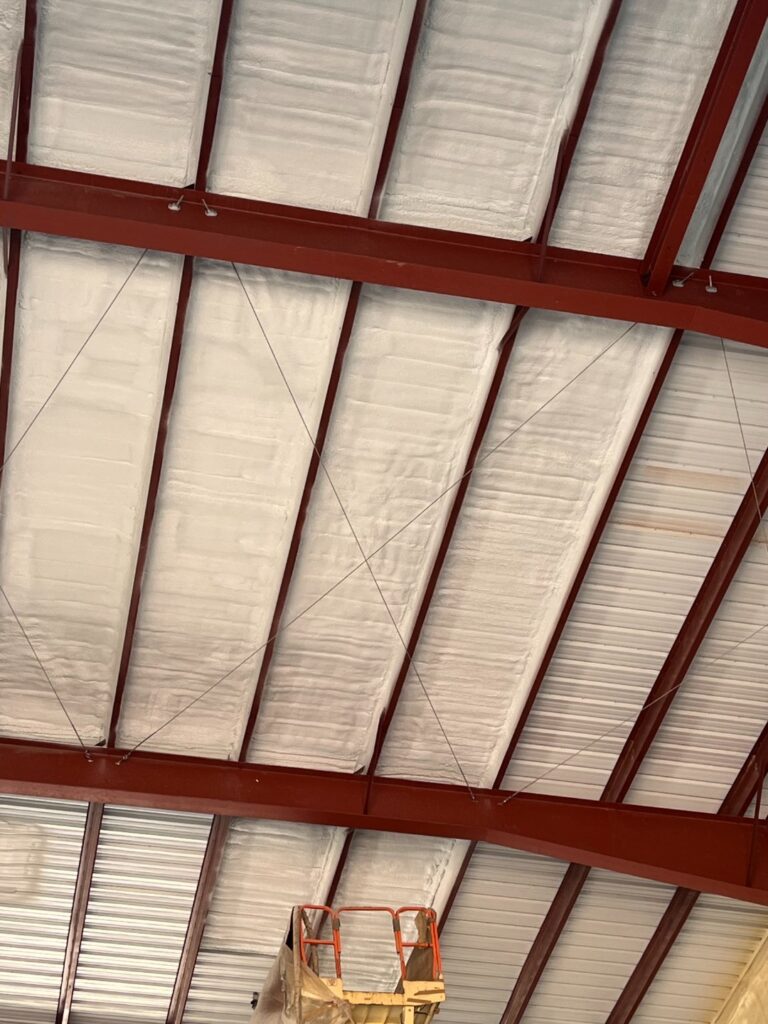
Insulating your attic with spray foam is one of the most important moves you can make towards improving your home. However, deciding between open-cell vs closed-cell attic spray foam can be a challenge.
Attic Spray Foam: Closed-Cell vs Open-Cell – What’s the Difference?
| Open Cell Spray | Closed Cell Spray | |
| Density | 0.4 to 1.2 lbs/ft³ | 2.0 lbs/ft³ |
| Perm rating* | 15 for a 2-inch depth | 1 for a 2-inch depth |
| R-value (Resistance to heat flow) | Around 3.5 per inch | Around 6.0 per inch |
| Cost | Lower | Higer |
*The higher the perm rating, the more moisture can pass through a material
Open Cell Spray
Pros and Cons
- Pro: Permeable – The foam enables a controlled diffusion of moisture vapor, which helps prevent buildup and promotes ventilation – making it good for roofing – and reduces the risk of condensation and mold growth.
- Con: Can’t be installed near water – Foam can act like a sponge – especially when used in areas prone to high humidity or leaks – which can lead to mold. If you live in a colder climate, you may need to have vapor barriers to protect your insulation.
- Pro: Energy efficient – Due to the nature of open cell foam and its air-sealing ability, it can greatly reduce air leakage, thus improving energy efficiency.
- Pro: Sound absorption – Great for reducing the ambient noise within a home, as the porous nature of the foam enables it to absorb sound waves.
- Con: Prone to compression – Because of the spongier and airier nature of open cell foam, it can shrink or lose its elasticity. This will affect its ability to insulate a space over time.
- Pro: Insulates hard-to-reach places – Due to the expansive nature of the foam, it can reach the furthest crevices and awkward spaces behind your walls.
- Pro: Cost-effective – It takes fewer chemicals to cover a larger area because the foam is less dense.
- Con: Use cases are limited – The foam won’t perform as well as closed-cell foam in extreme weather conditions.
Best Use Cases
- Residential construction insulation
- Under roof trusses for “conditioned attics.”
- As a spray foam sound insulation in media rooms.
- 2×6 walls and attics where thickness is not a constraint
- Interior walls and ceilings where soundproofing is a priority
- Attics and rooflines in warmer climates
- Spaces where vapor permeability is necessary
- Applications where the budget is a primary concern
Closed Cell Spray
Pros and Cons
- Pro: Higher R-Value – Closed-cell foam has a superior insulation rating per inch – the highest of any commercially available insulation. It provides maximum thermal resistance, maintaining the temperature of a space for longer.
- Con: Expensive – Because the foam is denser, it requires three times more raw chemicals to produce per board foot.
- Pro: Moisture barrier – It is highly resistant to water and can help prevent mold and mildew growth.
- Con: Conceals leaks – Because of its high water resistance, it stops water from passing through, hiding the original leak location and trapping moisture behind your walls, which can potentially cause unseen structural damage.
- Pro: Rigidity – Closed-cell spray foam can add structural integrity to your walls and roof because the cells don’t share walls. This means there is much more plastic compared to other types of insulation. Wall racking strength can be doubled or tripled when closed-cell foam is applied.
- Con: Rigidity – Because the foam is inflexible, it can make future electrical expansion difficult, as you’ll need to cut away the foam if you want to make any alterations.
- Pro: Excellent air seal – The foam prevents air leaks and reduces energy loss, making it ideal for extreme climates.
Best Use Cases
- Anywhere in the home (garages and basements)
- Robust insulation where space is an issue (can achieve two times the R-value of open cell spray foam inside a standard wall)
- Exterior walls and below-grade applications where moisture resistance is needed
- Areas subject to high humidity or potential water exposure
- Regions with extreme temperatures that require higher insulation performance
Closed-Cell vs Open-Cell Spray Foam: Which is the Best Option for Your Attic
The choice depends on your:
- Budget
- Climate
- Moisture concerns
- Application type
Closed-cell spray foam offers fantastic insulation and moisture resistance – even with a thinner application, while open-cell spray foam is great if you’re looking for a budget-friendly option or tackling a larger space in an area with a milder climate.
If you’re hoping to improve the energy efficiency of your home, or just have questions, don’t hesitate to reach out to the Seamless Systems team.