If you live in the Black Hills, your garage door does more than open and shut, it’s one of the biggest thermal weak points on your home. With cold, snowy winters and warm, sun-drenched summers means that any decision you make regarding your door will contribute to comfort and happiness, the cost of your energy bill, and the longevity of your door and belongings in the garage.
Below, we will summarize the real difference between insulated and non-insulated garage doors, how to utilize the climate factors in your area, and some practical suggestions for making the best choice for your Black Hills home.
What “Insulated” Actually Means For Garage Doors
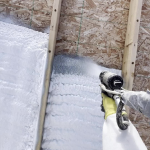
When someone says that a door is insulated, the overwhelming majority of people are talking about a door panel that has a foam core (usually polystyrene or polyurethane), and perhaps the door assembly also has thermal breaks, better seals, or thicker panels. Insulation increases the door’s R-value (Resistance to heat flow), higher R-value means better thermal performance. As manufacturers and the industry compare doors, they are also starting to mention U-factor (it measures how well a door lets heat through) in addition to R-value.
Two common insulation types:
- Polystyrene (EPS/XPS) panels: affordable, moderate R-value, lighter.
- Polyurethane (injected foam): higher R-value per inch, stronger panels, better long-term thermal performance (and higher cost).
Thermal breaks in the door’s construction (nonconductive material between inside and outside metal layers) and tight perimeter seals are also important — they prevent conductive heat transfer and drafts through the frame and edges.
Insulated Doors, The Real Benefits For Black Hills Homes
- Better year-round comfort. An insulated door reduces how much outdoor cold (or heat) bleeds into the garage and adjacent rooms. That matters more in the Black Hills because of the big winter lows and summer temperature swings.
- Lower HVAC load and energy savings. Because the garage is often adjacent to conditioned spaces, insulating the door means your furnace or AC doesn’t have to work as hard to compensate for that giant uninsulated opening. Multiple manufacturers and energy guides note measurable savings when a well-insulated door replaces a non-insulated one.
- Noise reduction. The extra mass and foam damp vibration and street noise, helpful if your garage is a workshop or sits under/next to living spaces.
- Less condensation and corrosion risk. Insulation plus good seals help keep the interior surface of the door warmer, lowering the chance of condensation and rust on tools, vehicles, or stored items.
- Stronger panels and better longevity. Polyurethane-filled panels add rigidity and resist dents better than thin uninsulated sections.
Non-Insulated Doors, When They Make Sense
- Lower upfront cost. For a tight budget or for garages that are purely vehicle storage and rarely used as living/work space, non-insulated doors are the cheaper option.
- Lighter weight & simpler repairs. They’re often lighter and slightly easier/cheaper to repair or repaint.
But in the Black Hills, the operating cost and comfort tradeoffs, especially for attached garages or garages used as workshops, often outweigh the lower purchase price.
How Much Insulation (R-value) Should You Consider?
Garage doors are typically rated from R-6 to R-8 for insulation, which is considered to be mid-grade insulated doors. Polyurethane cores can take you higher per panel, and outperform polystyrene in about every way. As a general rule, if your garage is attached, used as a workspace, or connects to a conditioned space, you should buy at the upper-end of the market (considering R-value or U-factor performance, and look for high-density polyurethane filled panels and thermal breaks. If the garage is detached and unconditioned, you may be ok with mid-grade insulated use or a non-insulated garage door.
Practical note: R-value comparisons are informative, but other construction details should also be considered, thermal breaks and perimeter seals, the quality of panel/joint construction, and installation make a big difference in performance.
Decision Guide, Which One Should You Choose?
- Opt for an insulated door if: you have an attached garage, the garage doubles as a workshop or hobby room, you keep anything that is temperature-sensitive, or noise reduction and longer-term protection are important to you. The cold winters and heavy snow of the Black Hills make insulation a good home-performance upgrade for most attached garages.
- Consider a non-insulated door if: your garage is detached, or unheated, or just used for occasional car storage, and you just want the lowest initial cost.
- When in doubt: get a site evaluation, and often the ultimate attention to detail in a properly installed insulated door with good seals and a thermal break will have its payback in comfort and reduced stress on the HVAC systems in a climate like the Black Hills.
Quick Maintenance Tips To Keep Any Door Performing Well
- Replace worn bottom seals and weatherstripping each few years, they’re inexpensive and cut drafts fast.
- Lubricate rollers and hinges before winter, and test the balance of the door (unbalanced doors strain springs and openers).
- If you have an insulated door, keep an eye on panel integrity, impact damage to the core can reduce effectiveness.
Seamless Systems Can Help
At Seamless Systems we treat garage doors as engineered systems. We’ll evaluate your garage’s use, the way it connects to your home, and local exposure to wind, snow, and sun, then recommend (and install) a solution that balances comfort and durability.
We’ll make the technology choices that actually work according to your climate. Want us to look at your garage and give a clear, no-pressure recommendation?
Reply with your town (Rapid City, Spearfish, Custer, etc.) and whether the garage is attached or detached, and we’ll walk you through the best options for your house and budget.